


Customer Behavior Modeling (CBM): Get To Know Your Buyers

Updated on July 7, 2026
Customer behavior models (CBM) are central to understanding why, when, and how people spend their money on a product or service. Applied well, they let you predict who is likely to buy and reach the right customers at the right moment with real precision.
This article covers the most valuable customer behavior models, the main types of buying behavior, and how to turn all of it into experiences that keep customers coming back.
Businesses have become far more analytical in how they make decisions, and that is where customer behavior modeling comes in. A customer behavior model is a method for explaining how and why people make buying decisions. Its main job is to map a predictable path through conversion, so you can guide customers smoothly through every stage of their journey.
CBMs can sound complicated, but they are not. They are a structured way to tell the story of a customer's behavior, and that story points you toward a better customer experience.
A customer behavior model reflects a person's buying habits, shaped by their demographics, beliefs, needs, goals, and more. Every person's approach to a purchase is unique, and a business that fails to account for that will watch the performance of its product or service slip. Customer data is the raw material for understanding those differences, drawn from email, social media, live chat, and mobile devices. Because CBMs are built mathematically, they carry a level of accuracy that makes them valuable to almost any industry.
The Benefits of Customer Behavior Modeling

Here are some of the biggest benefits of CBM.
Segmenting customers
CBM does what smart marketers do before any campaign: it groups people into smaller segments that share similar traits. That makes targeted campaigns easier to build and raises the odds of a strong conversion rate. For a deeper method here, see our guide to RFM Modeling.
Customer life-cycle tracking
The customer life-cycle describes the stages a customer moves through, acquisition, conversion, and retention, along with their growing loyalty to a business. At each stage, customers reveal different choices and spending habits, and CBM helps you monitor that journey for every segment. To track how groups of customers behave over time, cohort analysis is the natural next step.
Consumption pattern prediction
Retaining existing customers brings in more profit than acquiring new ones, which makes retention and churn central to success. Loyalty programs and well-timed marketing are your main tools for keeping customers, and behavior modeling tells you where to point them.
Marketing activity scaling
Automation is now essential, since it lets marketers design and execute intelligent campaigns that would otherwise take heavy manual work. Automation only works with precise segmentation underneath it, and CBM keeps that segmentation data ready, which opens the door to running campaigns at scale.
To understand your customers, you need to know who they are and what they want. You cannot meet every buyer one on one, so you study and segment them through direct feedback and market research, then build an accurate buyer persona from what you learn. Once you understand that persona, you can diagnose the pain points of a large part of your customer base and create content and offers that actually speak to them.
Types of Customer Behavior
.avif)
To understand customer behavior, start with the link between psychology and buying decisions, because people are influenced by many psychological factors. According to Henry Assael, customer behavior falls into four key types:
- Complex buying behavior
- Dissonance-reducing buying behavior
- Habitual buying behavior
- Variety-seeking behavior
Customer behavior depends on two main variables: how involved the person is in the purchase, and how different the competing products or brands are. Understanding those variables gives you a clearer picture of how leads interact with your product as they move through the journey. As a broader idea, customer behavior modeling raises the value of the customer relationship by giving you clear, usable knowledge about what people prefer.
How CBMs Drive Results
.avif)
Here is a closer look at how customer behavior models help a business grow.
Elevate customer lifetime value
Customer lifetime value is the total value a customer brings across their whole relationship with your business. Extending it should be a core goal, given how costly acquisition is. With behavior modeling, you can identify the segments that are ready for repeat purchases, cross-selling, and up-selling, then act on them.
Minimize customer churn
Across industries, customers who are about to leave tend to share warning signs. A bank, for example, might flag a customer who stops accepting recommended plans, reduces their activity, or gives negative feedback. CBM surfaces those signals early, drawing on data from email, social media, and CRM, so you can step in before revenue is lost. For the dedicated method, see our guide to churn prediction.
Personalization
Around half of customers say a personalized experience makes them more likely to buy again, while people treated as part of the crowd are far more likely to leave. Strong personalization is impossible without data, and CBM gives you the behavioral data to build highly targeted campaigns for each segment, which lifts conversions and ROI.
AI-Driven Approaches to Customer Behavior Modeling
Customer behavior modeling gets a major boost from artificial intelligence. AI systems work through huge volumes of data quickly and spot patterns humans would miss in how people interact with a product. Companies use predictive AI models to forecast what customers are likely to do next, from their probability of buying to their risk of churning, and to act on those forecasts while they still matter. All of that behavioral data is easier to unify and activate through a customer data platform.
Customer Behavior Modeling in iGaming
In iGaming, behavior modeling gets specific fast. Instead of broad personas, Smartico builds segments that combine a player's profile with their real behavior, for example, players who wagered more than €100 on slots in the last 30 days, or players whose session frequency dropped this week.
Those live segments feed straight into action. AI Models score each player's churn risk and predicted value, and CRM Automation triggers a tailored offer through the player's preferred channel, at the moment it is most likely to land. Gamification then keeps that player engaged with missions and rewards matched to how they play. The model stops being a theory on a slide and becomes a working retention loop: observe behavior, predict the next move, act, and measure the result.
Turn Behavior Models Into Action With Smartico
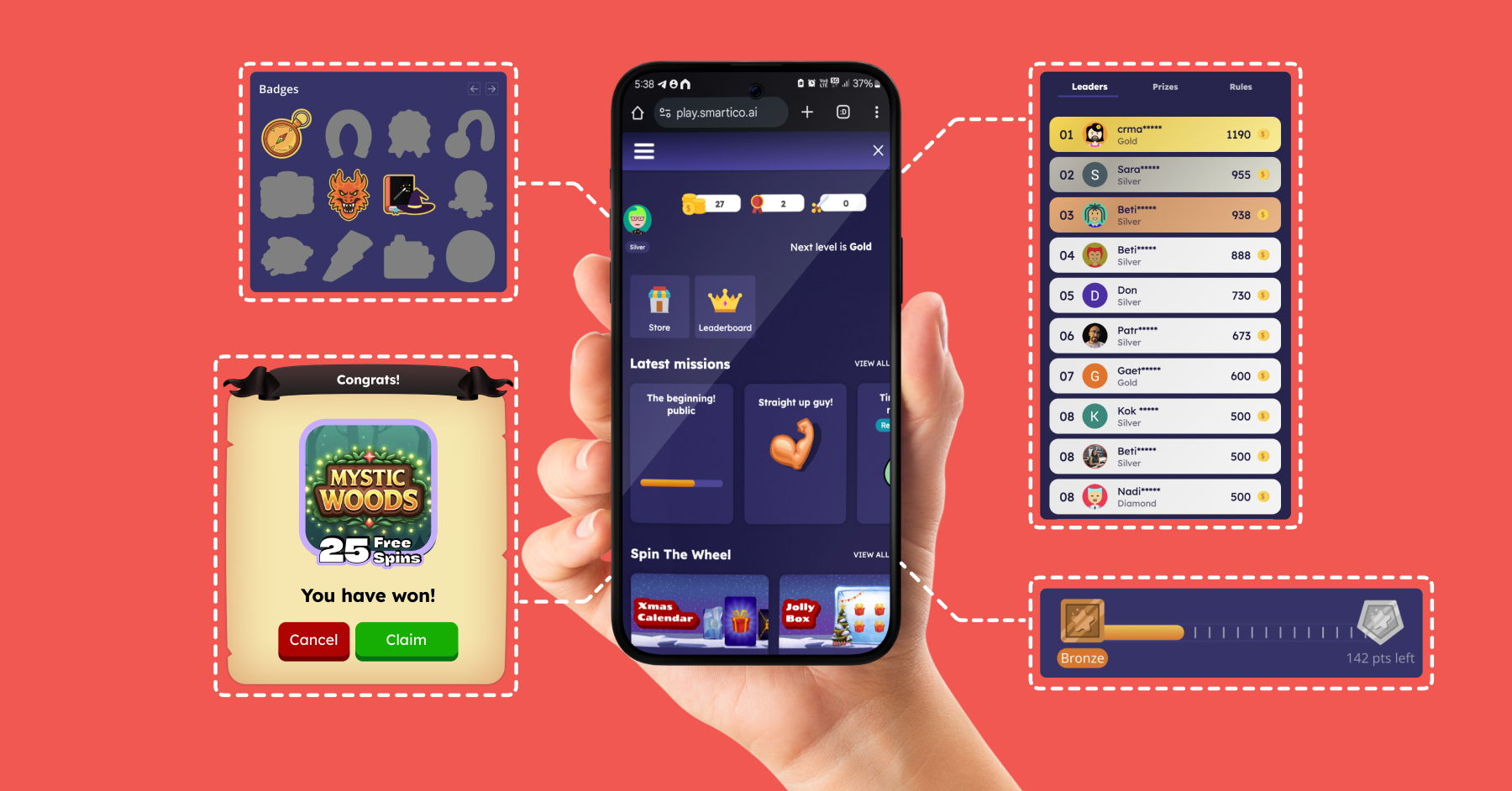
Understanding customer behavior is only half the job. The value shows up when you act on it automatically and at scale. Smartico is a unified CRM automation and gamification platform built for iGaming, and it closes the gap between insight and action, so the patterns you find in customer behavior turn into personalized experiences across email, SMS, push, and in-app messaging.
Want to see how it works on your player data? Book a demo and we'll walk you through it.